

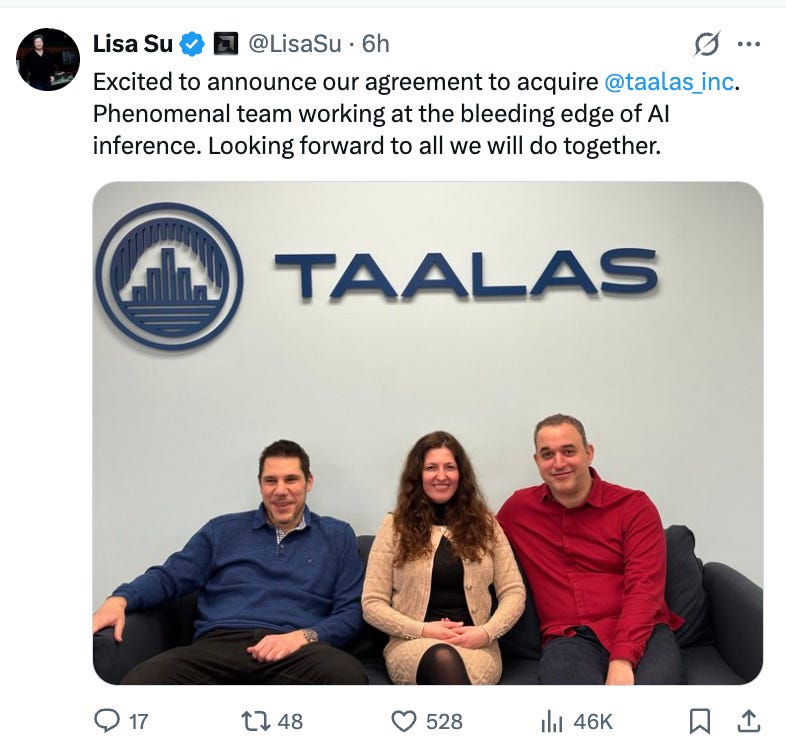
In The Custom ASIC Thesis we said Taalas was worth paying attention to, and in the Inference Inflection we said everything would go vertical. Our Baseten episode had some skeptical counterpoints against etched LLMs, not just custom ASICs, but clearly Lisa Su disagrees for now.

Congrats!
AI News for 8/5/2026-8/6/2026. We checked 12 subreddits, 544 Twitters and no further Discords. AINews’ website lets you search all past issues. As a reminder, AINews is now a section of Latent Space. You can opt in/out of email frequencies!
AI Twitter Recap
Meta’s Muse Spark 1.2 breakout: Olympiad golds, benchmark gains, and aggressive price-performance
Muse Spark 1.2 moved from “not on the board” to frontier-tier quickly. On Vals Index, Muse Spark 1.2 entered the top 5 at $0.69/test, reportedly 3x cheaper than Kimi and 10x+ cheaper than Fable, Opus, and 5.6 Sol. Vals later said it also became the first model above 60% on Finance Agent v2 at $0.77/test, versus the prior #1 Opus 5 at $5.12/test and at 2x the speed (ValsAI). Artificial Analysis’ v4.1.1 patch also noted one of the largest score increases for Muse Spark 1.2 after grading updates (Artificial Analysis).
Meta also claimed unusually strong “pure reasoning” results. Meta said its internally trained Muse Spark-family models achieved gold-medal-level performance in five STEM Olympiads, including perfect theory scores at APhO and IPhO, plus gold-level performance on IMO, IChO, and RMM; three were submitted under live competition conditions and officially graded (AI at Meta, Trapit Bansal). Meta emphasized no tools—no search, code, or calculator—and attributed some of the gains to multi-agent orchestration with parallel reasoning. That claim immediately fed into the ongoing “LLMs vs harnesses vs neurosymbolic” argument, with critics and supporters interpreting the setup differently (fchollet, giffmana).
The broader takeaway: engineers are increasingly treating agentic orchestration, TTC, and evaluation protocol as first-class product features. The Muse story is less “one model won” than “model quality + orchestration + pricing + serving capacity” now decides adoption. That framing showed up in reactions comparing Meta’s current velocity favorably to Google and highlighting that bigger “Watermelon” models are still expected (Rihard Jarc, alexandr_wang).
OpenAI’s ChatGPT model unification, free-tier expansion, and plugin/security push
OpenAI collapsed “instant” and “thinking” into one paid-chat model. The company announced that GPT-5.6 Sol now powers both Instant and deep reasoning for Plus/Pro users in ChatGPT, with a new reasoning-effort slider to choose speed vs comprehensiveness (OpenAI, OpenAI). OpenAI said the updated Sol yields 68% fewer factual-error responses than GPT-5.5 Instant on a high-stakes eval spanning finance, medicine, and law (OpenAI). Multiple OpenAI staff framed the change as a usability milestone: one model, one chat surface, adjustable effort (gdb, michpokrass).
Free-tier economics got much more aggressive. OpenAI said Free and Go users get unlimited text chats with GPT-5.6 Luna starting tomorrow, plus a Think button for harder questions (OpenAI). This was widely read as a major consumer-distribution move (sama, kimmonismus). ARC Prize also re-ran GPT-5.6 Luna after its 80% price cut and reported unchanged capability at much lower cost: 59.6% on ARC-AGI-2 for $0.18/task and 90.7% on ARC-AGI-1 for $0.07/task (arcprize).
Developer surface area also expanded. OpenAI introduced Agent Plugins, an open standard built with AWS, Cursor, GitHub, Vercel, and others for bundling Agent Skills and MCP server configs in a shared format, with launch support across Codex, ChatGPT, Cursor, GitHub Copilot, Kiro, and Code (OpenAIDevs, OpenAIDevs). OpenAI also launched Codex Security Review in research preview, aimed at doing repo-context-aware security review directly on GitHub PRs (OpenAIDevs, gdb).
Rumor watch: an unverified but highly amplified leak claimed “Astra”—described as OpenAI’s largest new pretrain since GPT-4.5 and internally called mewfour—could arrive next week (synthwavedd). The rumor spread widely, but there is no confirmation in the source set.
Agents, harnesses, and MCP infrastructure are becoming the real systems battleground
Cloudflare made one of the more substantive infra pushes of the day. During Agents Week, the company highlighted Kitesurf, a stateless browser running entirely on Workers, designed for agent use cases where full Chromium is overkill. The technical pitch: split script/DOM from rendering, lazily instantiate renderer workers only when needed, and dramatically cut CPU/memory overhead relative to standard browser automation (ashleypeacock, imluisduarte). Cloudflare also pushed WebMCP, AI Search upgrades, dashboard-level AI Readiness/AEO tooling, and a blog on MCP’s rewritten stateless core that better fits commodity web infra like Workers (mattzcarey).
MCP is moving from novelty to table stakes. Beyond Cloudflare, Weaviate added a built-in
/v1/mcpendpoint on the same port as the REST API with collection inspection, tenant listing, hybrid search, and object upsert tools—no separate MCP service required, with RBAC and independent toggles for MCP/write access (weaviate_io). MCP-compatible plugin packaging also got a boost from OpenAI’s Agent Plugins rollout and Cursor’s support for it (cursor_ai).The industry argument has shifted from “do harnesses matter?” to “where does intelligence live?”. François Chollet argued that a large inference-time harness orchestrating many neural calls is, by definition, neurosymbolic, and that current systems are often “symbolic sandwiches” rather than end-to-end neural programs (fchollet, fchollet, fchollet). Others pushed back that while harnesses determine capability, the model remains the core source of intelligence/generalization (Andrew Lampinen, Andrew Lampinen). This is now a practical engineering question, not philosophy: routing, orchestration, tool schemas, and eval harnesses are visibly altering outcomes.
Multi-agent patterns are getting productized. There were several signs of teams embracing swarm-like workflows: ad hoc thread-based agent coordination (swyx), Gemini agents self-naming and collaborating (fofrAI), Hugging Face/Gemma experiments with 149 collaborating agents and a new open math-proof collaboration effort (ClementDelangue, cmpatino_). Cognition also leaned heavily into cloud agents as persistent engineering capacity (cognition).
Open-model serving, routing, and cost engineering
Inference routing is becoming a competitive moat. Cursor described its Router as trained on millions of in-product interactions per week to classify and route requests for lower latency and cost, while explicitly acknowledging no single model dominates all task types: Grok 4.5 for routine tasks, GPT-5.6 Sol for planning/codebase comprehension, Opus 5 for execution-heavy work, Fable 5 for debugging/visual implementation (cursor_ai, cursor_ai).
Open-model availability kept broadening across platforms. Baseten became an official Hugging Face inference provider for Kimi K3, DeepSeek V4 Flash, and GLM-5.2 (baseten); Perplexity Computer made GPT-5.6 Terra the default model for subagents and Luna for scheduled automations (perplexity_ai, AravSrinivas); and GitHub Copilot began rolling out Kimi K3 hosted by Fireworks before pausing due to a GitHub Actions incident, while publishing pricing of $3/1M input, $15/1M output, and $0.30/1M cached input (code, github).
Cost/perf optimizations remain very material. Unsloth said DSpark makes DeepSeek-V4-Flash-0731 GGUFs run 1.4–2x faster locally with no accuracy change, reaching 120 tok/s in some settings (UnslothAI). Separate commentary on DeepSeek economics pointed out that even large aggregate serving volumes still imply relatively modest total token revenue at today’s pricing (thdxr).
vLLM and associated ecosystem companies continued to position around production-scale open serving. vLLM promoted verified Kimi K3 serving recipes (vllm_project) and conference plans, while Inferact/vLLM messaging emphasized 500K+ GPUs and day-zero open-model production infra (vllm_project, inferact).
Science, evaluation, and physical-world datasets
Google DeepMind open-sourced a high-impact weather model. WeatherNext 2, published in Nature, is claimed to provide roughly an extra day of lead time on tropical cyclone forecasting—described as about a decade of forecasting progress in a single jump—and is being released with code and model weights (GoogleDeepMind, NewsFromGoogle). Operationally, DeepMind said the system now produces 1,000 probabilistic predictions per storm and during Hurricane Melissa gave a Category 5 landfall prediction 5 days in advance with 80% confidence (GoogleDeepMind).
Benchmarks continue to specialize into domain reasoning rather than generic QA. Elicit introduced BioDecisionBench, a benchmark derived from 26 complex life-sciences reasoning failure cases across 40 task variants, focused on whether systems catch confounders, sensitivity issues, surrogate endpoints, and related errors in drug-development decision making (elicitorg). Epoch AI launched a new “game puzzles” benchmark using an undisclosed game to probe reasoning in likely out-of-distribution settings; Opus 5 currently leads at 59% (EpochAIResearch).
Physical AI data got a notable open release. RekaDaily-10k brings 10,312 hours of unscripted first-person household footage, including ~1,670 hours in native 4K, collected across the US, LatAm, Asia, and Africa, under Apache 2.0. Reka framed this as “the actual mess of the real world” needed for physical AI instead of synthetic or carefully staged data (RekaAILabs).
Interpretability and user-model interaction also saw concrete work. Transluce reported “user awareness” effects across 21 of 24 models tested, where model behavior shifts based on perceived user identity; for Claude, the strongest shifts clustered around AI safety researchers (TransluceAI). On the interpretability side, Goodfire highlighted use of Silico to probe representations in human motion models and VLMs (GoodfireAI, GoodfireAI).
Top tweets (by engagement, filtered for technical relevance)
OpenAI ChatGPT update: unified GPT-5.6 Sol for paid chats and unlimited GPT-5.6 Luna for free/go users (OpenAI).
OpenAI Agent Plugins: new cross-client standard for packaging skills and MCP server configs (OpenAIDevs).
OpenAI Astra rumor: widely shared but unverified claim of an imminent new large pretrain (synthwavedd).
Meta Olympiad results: five gold-medal-level performances from Muse Spark-family models under no-tool conditions (AIatMeta).
Cloudflare Kitesurf + MCP updates: one of the denser agent infra announcement bundles of the day (ashleypeacock).
AI Reddit Recap
/r/LocalLlama + /r/localLLM Recap
1. Qwen3.8-Max Release and Benchmarks
Qwen 3.8 Max now ranked as best overall model ahead of Opus 5 by Artificial Analysis agentic index (Activity: 947): The post claims Qwen 3.8 Max is ranked above Claude Opus 5 on the Artificial Analysis Agentic Index, a benchmark focused on GDPval-AA v2 and 𝜏³-Banking agentic evaluations. A top commenter disputes the claim, citing the linked screenshot showing Claude Opus 5 at
59.2versus Qwen 3.8 Max at58.4, i.e. Opus remains slightly ahead in that view. One commenter reports practical experience that Qwen is “so much better at PHP than Fable” for daily work, while another dismisses extrapolating smaller Qwen models’ scores as wishful thinking.A commenter disputes the post title’s ranking claim, noting the linked screenshot shows Claude Opus 5 ahead of Qwen 3.8 Max on the displayed metric:
59.2vs58.4(image). Another commenter clarifies that the claim appears to apply specifically to the Artificial Analysis agentic index, not necessarily overall model intelligence.One user reports practical coding-performance preference for Qwen over Fable in daily PHP development, though no benchmark numbers or task breakdowns are provided.
There is interest in smaller Qwen 27B/35B variants as local “dispatch agents”; one commenter claims Qwen 3.6 35B can run at roughly
700 tokens/son an RTX 5090 using nifter, suggesting a focus on high-throughput local agent orchestration rather than frontier-model quality.
Qwen3.8-2.4T-A95B (aka Qwen3.8-Max) open release time: next wednesday (Activity: 867): A ModelScope placeholder page indicates Qwen3.8-2.4T-A95B / Qwen3.8-Max will be openly released “next Wednesday” at
modelscope.cn/models/Qwen/Qwen3.8-2.4T-A95B. The page text says this is the first open-weight Qwen-Max-class model, with2.4Ttotal parameters andA95Bactive parameters, targeting improvements in coding, work, research, and long-horizon tasks; it also confirms Qwen3.8-27B and potentially additional Qwen3.8-series models will follow on separate pages. Commenters interpret the wording as meaning Qwen3.8-27B will be released after the Max-class model, and note that “other model(s)” implies more variants beyond 27B. One technical concern raised is the practical storage/I/O burden of local inference for a2.4T-parameter MoE model, jokingly suggesting RAID0 across many SSDs.Commenters parsed the release wording as confirming Qwen3.8-2.4T-A95B / Qwen3.8-Max will be released first, with Qwen3.8-27B and potentially other Qwen3.8-series models arriving later on separate pages. The quoted announcement says this is the first open-weight Qwen-Max-class model, a
2.4Tparameter MoE-style model withA95Bactive parameters, targeting coding, work, research, and long-horizon tasks.The announced Qwen3.8-27B is described as offering “flagship-level intelligence” at a condensed
27Bsize, implying a smaller dense or compact model intended to make the Qwen3.8 generation usable on far more modest hardware than the2.4T-A95Brelease. One commenter notes the wording suggests there may be additional models beyond just the 27B variant.There is technical concern about local inference requirements for the
2.4T-A95Bmodel, with one commenter joking they would need aRAID0array of32SSDs for SSD-based inference. While exaggerated, it reflects the practical storage and bandwidth challenges of running a multi-trillion-parameter open-weight model locally, especially if weights cannot fit fully in GPU memory.
Qwen Developers’ responses from their recent Twitter/X AMA (Activity: 534): The image is a Qwen-branded AMA promotional graphic, not a technical diagram or benchmark; its significance is contextual, advertising the Twitter/X AMA summarized in the post. The AMA responses claim an upcoming Qwen
3.827B release, with Qwen3.8reportedly using2.4Ttotal parameters /95Bactive params for the larger model, “different thinking efforts,” a 100h+ video-understanding system based on hierarchical video memory with structured scene/entity/event graphs, and quantization advice to keep attention QKV/output projections in16-bitwhile quantizing FFN to4-bitor using QAT. Commenters were skeptical of the AMA’s substance, calling many answers “laughably vague,” noting evasions around the122Bmodel, and questioning why users keep asking for another CLI/harness instead of focusing on model capabilities or releases.


2. Open-Source AI Tooling: TTS and Agents
Qwen3-TTS voice cloning is now in mainline llama.cpp — the old demo finally became real support (Activity: 527): The image is a Qwen3-TTS promotional/architecture infographic showing voice cloning, controllable speech generation, and the model pipeline: Qwen3 LM, MTP, codec/text tokens, speaker embeddings, and a streaming codec decoder (image). In context, the post’s technical significance is that Qwen3-TTS-12Hz-1.7B-Base GGUF support has landed in mainline
llama.cppviallama-tts, enabling local multilingual voice cloning from WAV/MP3 speaker references, though/ttsserver support remains a draft PR and benchmarks vsqwen3-tts.cpp/audio.cppare still missing. Commenters are interested in broaderllama.cppsupport for TTS/STT models, especially compared with existing ROCm/CUDA-specific implementations. The maintainer ofaudio.cppexplicitly welcomed fair benchmarks to identify optimization opportunities.audio.cpp maintainer benchmarked Qwen3-TTS 12Hz 1.7B Base Q8 GGUF on an RTX 5090/CUDA using
audiocpp_cli --metrics --threads 8. Across five ~300-character clone requests, throughput was roughly7.5x–8.6xrealtime with average RTF around0.13, and enablingflash_attentiononly slightly changed performance (0.130437RTF off vs0.129289on).Using a shortened 2s reference clip improved average throughput in the audio.cpp test from about
7.73xto8.22xrealtime, suggesting reference-audio length has measurable latency impact for Qwen3-TTS cloning. Individual requests with the 2s reference ranged from1955–2307 mswall time for15.5–19.2sgenerated audio.Commenters compared the new mainline
llama.cppQwen3-TTS support with existing specialized implementations such asqwen3-tts.cppon ROCm,faster-qwen3-ttson CUDA, and audio.cpp, which claims mainline support for 50+ audio models, GGUF quantizations including Q8 and fp16, plus TTS, STT, and voice cloning workflows.
Prime Agent - a new coding harness surpassing Codex/CC/PI (Activity: 431): Prime Intellect announced Prime Agent, an open-source coding/research agent harness built on
piwith programmatic tool calling, “context as a variable,” multi-agent messaging, persistent execution, and a self-modifiable harness state. The post claims95.5%on ARC-AGI-3, exceeding the stated human-expert baseline, and says the harness improves multiple models versus proprietary harnesses; supporting material is in the blog post and X announcement. Commenters were skeptical that ARC-AGI-3 is a meaningful harness benchmark and argued the technical mechanism is underspecified: “subagents are always just tool calls” and self-modifying harnesses may not generalize outside repeated benchmark runs. They requested comparisons against stronger coding-agent baselines such as Cline, Droid, Junie, Cursor, ForgeCode with context servers rather than only proprietary/default harnesses.A commenter with prior harness experience (
L3tum/little-coder) criticized the lack of implementation detail around Prime Agent’s claimed self-modifying harness. They argued that most models are not trained to exploit self-modification reliably, and that benchmarking with “the literally best model there is” against a basic harness does not establish a meaningful harness-level advantage.There was technical skepticism about the claimed architecture: the persistent
iPythonexecution environment appears to be a core differentiator, but commenters questioned why Python was chosen instead ofTS/JSgiven Pi’s ecosystem, and how it differs from a conventional harness with self-modifying behavior. One concern was that repeated benchmark executions could let the system converge on benchmark-specific improvements, while a fresh run would need stronger evidence to show superiority over other harnesses.Multiple commenters asked for stronger comparative evaluation against established coding agents/harnesses such as Cline, Droid, Junie, Cursor, and ForgeCode with context server, rather than only comparisons to proprietary baselines. Another commenter identified RLM-based context management as the most technically significant claimed feature, while another questioned whether ARC-AGI 3 is an appropriate benchmark for evaluating coding harnesses.

3. Open-Weight Policy and License Enforcement
MiniMax issues (Activity: 888): The image is a screenshot of a prior r/StableDiffusion post alleging that MiniMax issued takedown pressure over “decensor/explicit H3 LoRAs,” warning a Hugging Face uploader that violating MiniMax’s model license could lead to license revocation, after which the file reportedly disappeared. In context of the title “MiniMax issues,” the technical significance is licensing/enforcement around derivative LoRA fine-tunes rather than model performance: users are concerned that platforms like Hugging Face or CivitAI may remove LoRAs derived from MiniMax/H3 if they violate the upstream model’s restrictive terms. Image: i.redd.it/urolt08gujhh1.jpeg Commenters largely frame this as an “open weights vs open source” issue: MiniMax may be within its rights to enforce a restrictive license, but that means the model should not be treated as truly open. Some commenters suggest renaming or obfuscating LoRAs to avoid affiliation, while others ask where the removed LoRA can still be found.
Commenters argued that MiniMax’s release terms are restrictive enough that the model should not be described as truly “open source,” even if the weights are available. The discussion frames this as a licensing distinction: permissive access to model weights does not necessarily satisfy the broader open-source definition when downstream uses such as LoRA publication or affiliation are constrained.
A linked screenshot of MiniMax’s responses was interpreted as suggesting the company is enforcing restrictions mainly to “cover their bases,” rather than aggressively suppressing derivative LoRAs. One commenter also noted that the base model is already “incredibly uncensored,” questioning the technical need for additional uncensoring LoRAs.
There was criticism of an asymmetry between restricting user-created LoRAs and the likely composition of the model’s training data. A commenter alleged the model may have been trained on copyrighted media franchises such as Star Trek, Star Wars, South Park, and Seinfeld, raising questions about dataset licensing versus downstream usage restrictions.
White House AI Guidelines Exempt U.S. Open Models From Government Review (Activity: 522): The post links a WSJ article titled “White House AI Guidelines Exempt U.S. Open Models From Government Review” (WSJ; archived), but the supplied content contains no article body beyond a CAPTCHA/access warning, so the exact scope, definitions, and review thresholds of the guidelines cannot be verified from the provided material. The technical implication discussed is that U.S. open-weight/open models may avoid certain government review requirements, potentially changing incentives for domestic labs relative to closed frontier models. Commenters speculate that exempting U.S. open models could encourage forks of Chinese open models and argue that U.S. labs should release more large open-weight models and smaller distilled variants, noting that China’s
2T+-scale open models are currently seen as strong competition.Commenters highlighted that the exemption could make open-weight models strategically important: Chinese open models may be forked or repackaged by U.S. actors, while U.S. labs are seen as lagging in releasing competitive open weights. One commenter specifically called out China’s “
2T+models” as strong examples and argued the U.S. should respond with both large open-weight releases and distilled smaller variants.A quoted passage from the article says only makers of closed, proprietary U.S. models demonstrating state-of-the-art cybersecurity/hacking capability on benchmarks would be asked to submit models for government testing before release, while open models are exempt. A commenter noted the ambiguity/contradiction in describing this as “voluntary” pre-release review, raising questions about how such benchmark-triggered review would actually be enforced.
China’s Open-Weight Models Will Be Spared US Safety Tests (Activity: 506): The post references a Bloomberg report titled “China’s Open-Weight Models Will Be Spared US Safety Tests,” but the supplied Bloomberg page is not accessible beyond an anti-bot/CAPTCHA notice, so no primary technical details about the policy scope, covered model classes, thresholds, or testing regime are available. Based on the title alone, the apparent claim is that Chinese open-weight AI models would not be subject to proposed or existing US safety-testing requirements, likely because the models are distributed openly and outside direct US regulatory control. Commenters argued that enforcement against Chinese open-weight models would be impractical: the US has limited jurisdiction over foreign model publishers, the weights are often freely downloadable rather than export transactions, and broad sanctions or secondary enforcement could be economically disruptive given widespread global and US corporate use.
Commenters argued that US safety-test requirements are difficult to apply to Chinese open-weight models like Qwen and DeepSeek because the model providers are outside US jurisdiction and the weights are often freely downloadable rather than conventional paid exports. One commenter noted that sanctions or secondary enforcement would be hard once models are already globally mirrored and integrated into downstream systems.
A recurring technical-policy concern was that asymmetric US regulation could unintentionally advantage Chinese open-weight ecosystems: if US models face additional safety/compliance burdens while Qwen/DeepSeek remain broadly usable, they may continue to dominate open-source benchmarks and leaderboards. This was framed as regulatory capture producing a stimulus effect for non-US model providers.
One commenter highlighted an enterprise deployment split: even if Chinese open-weight models remain accessible, applications requiring formal compliance, vendor accountability, provenance, or auditable safety documentation may be unable to use “unknown” models. This suggests adoption may diverge between informal/open-source experimentation and regulated enterprise environments.

Less Technical AI Subreddit Recap
/r/Singularity, /r/Oobabooga, /r/MachineLearning, /r/OpenAI, /r/ClaudeAI, /r/StableDiffusion, /r/ChatGPT, /r/ChatGPTCoding, /r/aivideo, /r/aivideo