

AI News for 2/4/2026-2/5/2026. We checked 12 subreddits, 544 Twitters and 24 Discords (254 channels, and 9460 messages) for you. Estimated reading time saved (at 200wpm): 731 minutes. AINews’ website lets you search all past issues. As a reminder, AINews is now a section of Latent Space. You can opt in/out of email frequencies!
If you think the simultaneous release of Claude Opus 4.6 and GPT-5.3-Codex is sheer coincidence, you’re not sufficiently appreciating the intensity of the competition between the two leading coding model labs in the world right now. It has never been as clear from:
in Consumer, the dueling Superbowl Ad campaigns (and subsequent defense from sama)
in the Enterprise, Anthropic releasing knowledge work plugins vs OpenAI launching Frontier, an enterprise-scale agents platform for knowledge work (with a ~50% collapse in SaaS stocks as collateral damage)
to the synced Coding launches today.
From a pure PR point of view, Anthropic won the day via distributed denial of developer attention across their 1m context and new custom compaction and adaptive thinking and effort and Claude Code agent teams and Claude in Powerpoint/Excel and 500 zero-days and C compiler task and use of mechinterp and ai consciousness callouts and $50 promos, whereas OpenAI won on most benchmarks with 25% higher speed with higher token efficiency and touted more web development skills, but it’s likely that all first day third party reactions are either biased or superficial. Here is Opus making visual comparisons of the different announcements:
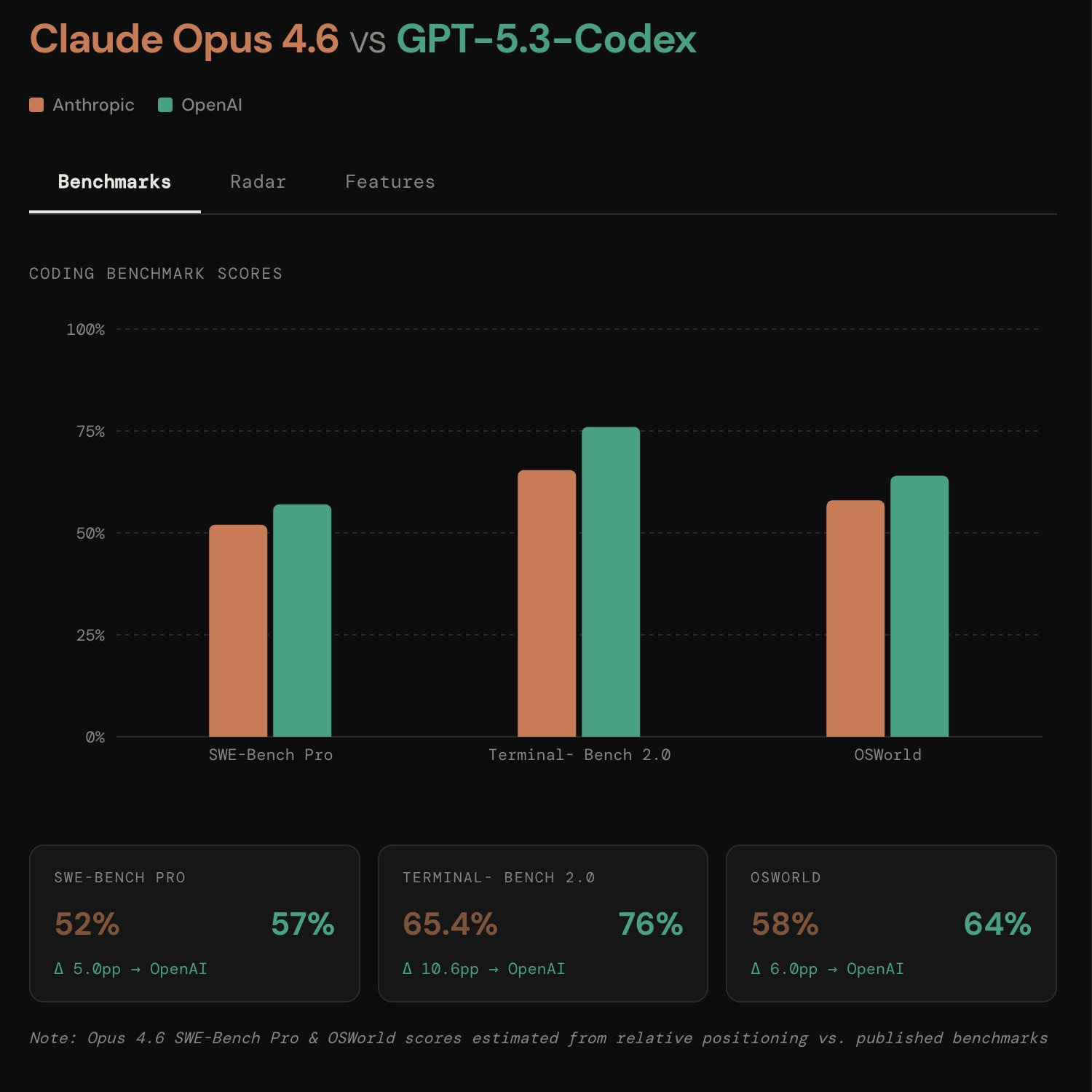
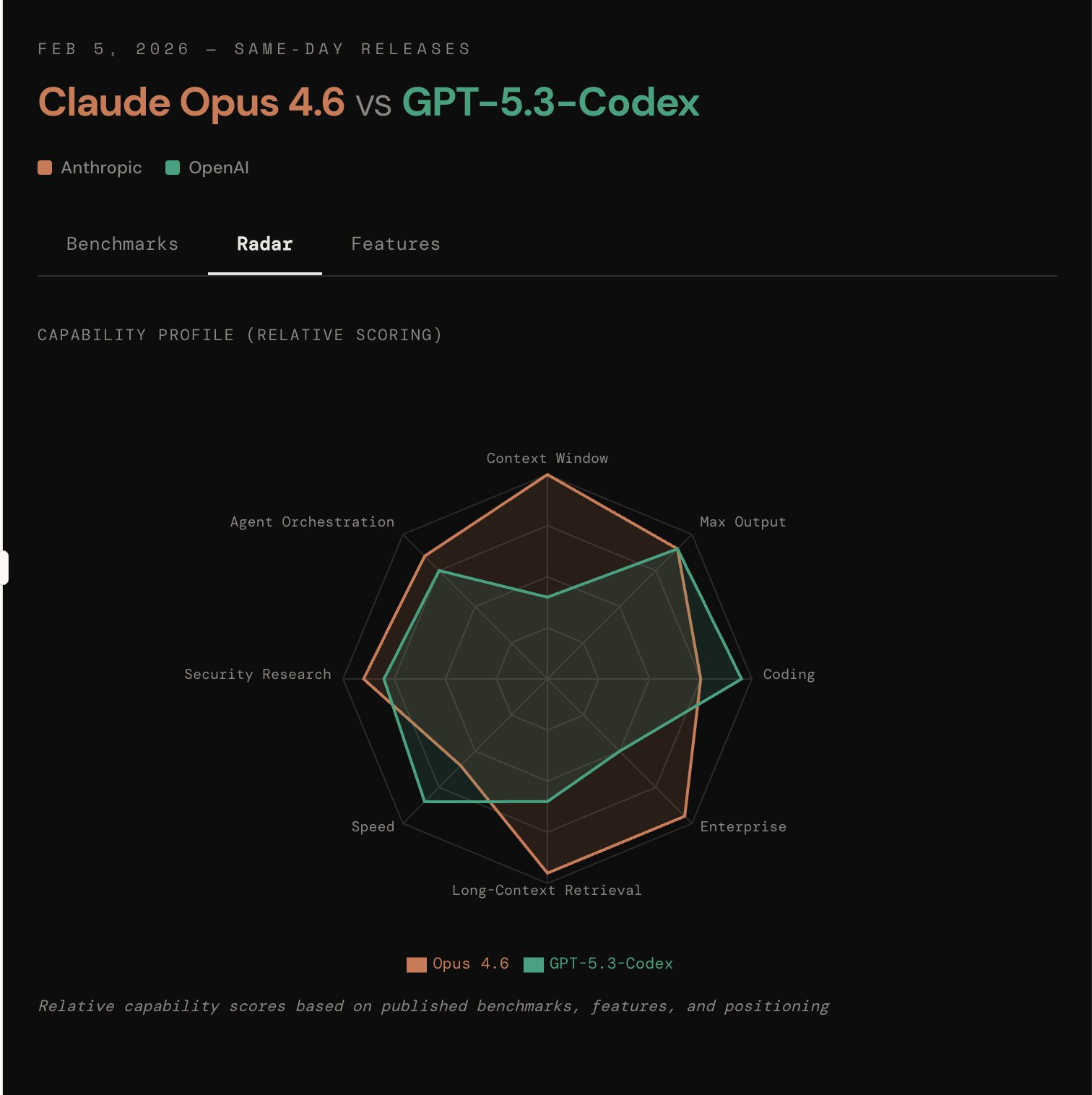
Both are minor version bumps, which will set the stage for Claude 5 and GPT 6 battles this summer.
Your move, GDM and SpaceXai.
AI Twitter Recap
Top tweets (by engagement)
Frontier lab engineering: Anthropic’s post on using agent teams + Opus 4.6 to build a clean-room C compiler that boots Linux drew major attention (tweet).
OpenAI release: GPT-5.3-Codex launch (and Codex product updates) landed as the biggest pure-AI product event (tweet).
OpenAI GPT-5.3-Codex + “Frontier” agent platform (performance, efficiency, infra co-design)
GPT-5.3-Codex shipped in Codex: OpenAI announced GPT-5.3-Codex now available in Codex (“You can just build things”) (tweet) and framed it as advancing frontier coding + professional knowledge in one model (tweet).
Community reaction highlighted that token efficiency + inference speed may be the most strategically important delta vs prior generations (tweet), with one benchmark claim: TerminalBench 2 = 65.4% and a head-to-head “demolished Opus 4.6” narrative circulating immediately after launch (tweet).
Reported efficiency improvements: 2.09× fewer tokens vs GPT-5.2-Codex-xhigh on SWE-Bench-Pro, and together with ~40% speedup implies 2.93× faster at ~+1% score (tweet). This theme was echoed by practitioners as a sign that 2026 is no longer assuming “infinite budget compute” (tweet).
Hardware/software co-design for GB200: A notable systems angle: OpenAI engineers describe the model as “designed for GB200-NVL72” and mention ISA nitpicking, rack sims, and tailoring architecture to the system (tweet). Separate “fruits of long-term collaboration with NVIDIA” posts reinforce that model gains are arriving with platform-specific optimization (tweet).
OpenAI Frontier (agents platform): OpenAI’s “Frontier” is positioned as a platform to build/deploy/manage agents with business context, execution environments (tools/code), learning-on-the-job, and identity/permissions (tweet). A separate report quotes Fidji Simo emphasizing partnering with an ecosystem rather than building everything internally (tweet).
Internal adoption playbook for agentic software dev: A detailed post lays out OpenAI’s operational push: by March 31, for technical tasks the “tool of first resort” should be an agent, with team processes like AGENTS.md, “skills” libraries, tool inventories exposed via CLI/MCP, agent-first codebases, and “say no to slop” review/accountability norms (tweet). This is one of the clearer public examples of how a frontier lab is trying to industrialize “agent trajectories → mergeable code.”
Developer ecosystem activation: Codex hackathon and ongoing builder showcases amplify “ship velocity” positioning (tweet, tweet). There’s also active curiosity about computer-use parity stacks (e.g., OSWorld-Verified claims, agent browser vs Chrome MCP APIs) and a request for OpenAI to benchmark and recommend the “right” harness (tweet, tweet).
Anthropic Claude Opus 4.6: agentic coding, long-context, and benchmarking “noise”
Autonomous C compiler as a forcing function for “agent teams”: Anthropic reports assigning Opus 4.6 agent teams to build a C compiler, then “mostly walking away”; after ~2 weeks it worked on the Linux kernel (tweet). A widely-shared excerpt claims: “clean-room” (no internet), ~100K lines, boots Linux 6.9 on x86/ARM/RISC‑V, compiles major projects (QEMU/FFmpeg/SQLite/postgres/redis), and hits ~99% on several test suites incl. GCC torture tests, plus the Doom litmus test (tweet).
Benchmarking reliability & infra noise: Anthropic published a second engineering post quantifying that infrastructure configuration can swing agentic coding benchmark results by multiple percentage points, sometimes larger than leaderboard gaps (tweet). This lands in the middle of a community debate about inconsistent benchmark choices and limited overlap (often only TerminalBench 2.0) (tweet).
Distribution + product hooks: Opus 4.6 availability expanded quickly—e.g. Windsurf (tweet), Replit Agent 3 (tweet), Cline integration emphasizing CLI autonomous mode (tweet). There’s also an incentive: many Claude Code users can claim $50 credit in the usage dashboard (tweet).
Claims about uplift and limits: A system-card line circulating claims staff-estimated productivity uplift 30%–700% (mean 152%, median 100%) (tweet). Yet internal staff reportedly do not see Opus 4.6 as a near-term “drop-in replacement for entry-level researchers” within 3 months, even with scaffolding (tweet; related discussion tweet).
Model positioning and “sandbagging” speculation: Some observers suggested Opus 4.6’s gains might come from longer thinking rather than a larger base model, with speculation it might be “Sonnet-ish” but with higher reasoning token budget (not confirmed) (tweet; skeptical reaction tweet). Separate chatter referenced “Sonnet 5 leaks” and sandbagging theories (tweet).
Leaderboards: Vals AI claims Opus 4.6 #1 on the Vals Index and SOTA on several agentic benchmarks (FinanceAgent/ProofBench/TaxEval/SWE-Bench) (tweet), while the broader ecosystem debated which benchmarks matter and how to compare.
New research: routing/coordination for agents, multi-agent efficiency, and “harnesses”
SALE (Strategy Auctions for Workload Efficiency): Meta Superintelligence Labs research proposes an auction-like router: candidate agents submit short strategic plans, peer-judged for value, and cost-estimated; the “best cost-value” wins. It reports +3.5 pass@1 on deep-search while cutting cost 35%, and +2.7 pass@1 on coding at 25% lower cost, with 53% reduced reliance on the largest agent (tweet; paper link in tweet). This is a concrete alternative to classifiers/FrugalGPT-style cascades under rising task complexity.
Agent Primitives (latent MAS building blocks): A proposed decomposition of multi-agent systems into reusable primitives—Review, Voting/Selection, Planning/Execution—where agents communicate via KV-cache instead of natural language to reduce degradation and overhead. Reported: 12.0–16.5% average accuracy gains over single-agent baselines across 8 benchmarks, and a large GPQA-Diamond jump (53.2% vs 33.6–40.2% prior methods), with 3–4× lower token/latency than text-based MAS (but 1.3–1.6× overhead vs single-agent) (tweet; paper link in tweet).
“Teams hold experts back”: Work arguing fixed workflows/roles can cap expert performance as tasks scale, motivating adaptive workflow synthesis (tweet).
Tooling shift: frameworks → harnesses: Multiple threads emphasized that the LLM is “just the engine”; reliability comes from a strict harness that enforces planning/memory/verification loops, plus patterns like sub-agent spawning to preserve manager context (tweet) and Kenton Varda’s observation that “low-hanging fruit” in harnesses is producing wins everywhere (tweet).
Parallel agents in IDE/CLI: GitHub Copilot CLI introduced “Fleets”—dispatch parallel subagents with a session SQLite DB to track dependency-aware tasks/TODOs (tweet). VS Code positioned itself as a “home for multi-agent development” managing local/background/cloud agents, including Claude/Codex, under Copilot subscription (tweet). VS Code Insiders adds agent steering and message queueing (tweet).
Training & efficiency research: tiny fine-tuning, RL objectives, continual learning, privacy, long context
TinyLoRA: “Learning to Reason in 13 Parameters”: A PhD capstone claims a fine-tuning approach where (with TinyLoRA + RL) a 7B Qwen model improved GSM8K 76% → 91% using only 13 trainable parameters (tweet). If reproducible, this is a striking data point for “extreme low-DOF” adaptation for reasoning.
Maximum Likelihood Reinforcement Learning (MaxRL): Proposes an objective interpolating between REINFORCE and maximum likelihood; the algorithm is described as a near “one-line change” (normalize advantage by mean reward). Claims: better sample efficiency, Pareto-dominates GRPO on reasoning, better scaling dynamics (larger gradients on harder problems) (tweet; paper linked there).
RL with log-prob rewards: A study argues you can “bridge verifiable and non-verifiable settings” by using (log)prob rewards tied to next-token prediction loss (tweet).
SIEVE for sample-efficient continual learning from natural language: Distills natural-language context (instructions/feedback/rules) into weights with as few as 3 examples, outperforming prior methods and some ICL baselines (tweet). Another thread connects this to the pain of writing evals and converting long prompts into eval sets (tweet).
Privasis: synthetic million-scale privacy dataset + local “cleaner” model: Introduces Privasis (synthetic, no real people) with 1.4M records, 55M+ annotated attributes, 100K sanitization pairs; trains a 4B “Privasis-Cleaner” claimed to outperform o3 and GPT-5 on end-to-end sanitization, enabling local privacy guards that intercept sensitive data before sending to remote agents (tweet).
Long-context efficiency: Zyphra AI released OVQ-attention for efficient long-context processing, aiming to balance compression vs memory/compute cost (tweet; paper link tweet).
Distillation provenance: “Antidistillation Fingerprinting (ADFP)” proposes provenance verification aligned to student learning dynamics (tweet).
Industry, adoption, and “agents eating knowledge work” narratives (with pushback)
GitHub commits attributed to agents: SemiAnalysis-cited claim: 4% of GitHub public commits authored by Claude Code, projecting 20%+ by end of 2026 (tweet). Another thread notes this moved from 2%→4% in a month (tweet). Treat as directional: attribution methodology and sampling matter.
Work transformation framing: A popular “Just Make It” ladder argues labor shifts from doing → directing → approving as models produce bigger chunks of work from vaguer instructions, first visible in coding then spreading to media/games (tweet). Corbtt predicts office spreadsheet/memo work disappears from many roles within ~2 years (tweet)—with a follow-up nuance that roles may persist as sinecures but the opportunity to be hired into them vanishes (tweet).
More measured labor-market analogy: François Chollet points to translators as a real-world case where AI can automate most output, yet FTE counts stayed stable while work shifted to post-editing, volume rose, rates fell, and freelancers were cut—suggesting software may follow a similar pattern rather than “jobs disappear overnight” (tweet).
Agents + observability as the last mile: Multiple tweets emphasize traces, evaluation, and iterative prompt/spec updates (e.g., Claude Code “/insights” analyzing sessions and suggesting CLAUDE.md updates) as the boundary where “model improvements end” and product reliability begins (tweet).
Decentralized eval infra: Hugging Face launched Community Evals and Benchmark repositories to centralize reported scores in a transparent way (PR-based, in model repos) even if score variance remains (tweet)—timely given the day’s benchmark confusion.
(Smaller) notable items outside core AI engineering
AGI definition discourse: Andrew Ng argues “AGI” has become meaningless because definitions vary; by the original “any intellectual task a person can” measure, he thinks we’re decades away (tweet).
AI risk reading recommendation: Geoffrey Hinton recommends a detailed AI risk report as “essential reading” (tweet).
AI Reddit Recap
/r/LocalLlama + /r/localLLM Recap
1. Local LLMs for Coding and AI Usage
Anyone here actually using AI fully offline? (Activity: 290): Running AI models fully offline is feasible with tools like LM Studio, which allows users to select models from Hugging Face based on their hardware capabilities, such as GPU or RAM. Another option is Ollama, which also supports local model execution. For a more interactive experience, openwebUI provides a local web interface similar to ChatGPT, and can be combined with ComfyUI for image generation, though this setup is more complex. These tools enable offline AI use without relying on cloud services, offering flexibility and control over the models. Some users report successful offline AI use for tasks like coding and consulting, with varying hardware requirements. While coding workflows may need more powerful setups, consulting tasks can be managed with models like
gpt-oss-20bin LM Studio, indicating diverse use cases and hardware adaptability.Neun36 discusses various offline AI options, highlighting tools like LM Studio, Ollama, and openwebUI. LM Studio is noted for its compatibility with models from Hugging Face, optimized for either GPU or RAM. Ollama offers local model hosting, and openwebUI provides a local web interface similar to ChatGPT, with the added complexity of integrating ComfyUI for image generation.
dsartori mentions using AI offline for coding, consulting, and community organizing, emphasizing that coding requires a more robust setup. They reference a teammate who uses the
gpt-oss-20bmodel in LMStudio, indicating its utility in consulting workflows, though not exclusively.DatBass612 shares their experience with a high-end M3 Ultra setup, achieving a positive ROI in 5 months while running OSS 120B models. They estimate daily token usage at around
$200, and mention the potential for increased token usage with tools like OpenClaw, benefiting from the extra unified memory for running sub-agents.
Is running a local LLM for coding actually cheaper (and practical) vs Cursor / Copilot / JetBrains AI? (Activity: 229): The post discusses the feasibility of running a local Large Language Model (LLM) for coding tasks as an alternative to cloud-based services like Cursor, Copilot, and JetBrains AI. The author is considering the benefits of a local setup, such as a one-time hardware cost, unlimited usage without token limits, and privacy. They inquire about the practicality of local models like Code Llama, DeepSeek-Coder, and Qwen-Coder, and the hardware requirements, which might include a high-end GPU or dual GPUs and 64–128GB RAM. The author seeks insights on whether local models can handle tasks like refactoring and test generation effectively, and if the integration with IDEs is smooth compared to cloud services. Commenters suggest that local models like Qwen Coder and GLM 4.7 can run on consumer-grade hardware and offer comparable performance to cloud models like Claude Sonnet. However, they caution that state-of-the-art models may soon require more expensive hardware. A hybrid approach, combining local and cloud resources, is recommended for specific use cases, especially with large codebases. One commenter notes that a high-end local setup could outperform cloud models if fine-tuned for specific tasks, though the initial investment is significant.
TheAussieWatchGuy highlights that models like Qwen Coder and GLM 4.7 can run on consumer-grade hardware, offering results comparable to Claude Sonnet. However, the rapid advancement in AI models, such as Kimi 2.5 requiring
96GB+ VRAM, suggests that maintaining affordability might be challenging as state-of-the-art models evolve, potentially making cloud solutions more cost-effective in the long run.Big_River_ suggests a hybrid approach combining local and cloud resources, particularly beneficial for large, established codebases. They argue that investing around
$20kin fine-tuned models tailored to specific use cases can outperform cloud solutions, especially considering ownership of dependencies amidst geopolitical and economic uncertainties.Look_0ver_There discusses the trade-offs between local and cloud models, emphasizing privacy and flexibility. Local models allow switching between different models without multiple subscriptions, though they may lag behind the latest online models by approximately six months. The commenter notes that recent local models have significantly improved, making them viable for various development tasks.
Why are people constantly raving about using local LLMs when the hardware to run it well will cost so much more in the end then just paying for ChatGPT subscription? (Activity: 84): The post discusses the challenges of running local Large Language Models (LLMs) on consumer-grade hardware, specifically an RTX 3080, which resulted in slow and poor-quality responses. The user contrasts this with the performance of paid services like ChatGPT, highlighting the trade-off between privacy and performance. Local LLMs, especially those with 10 to 30 billion parameters, can perform complex tasks but require high-end hardware for optimal performance. Models with fewer parameters (1B to 7B) can run successfully on personal computers, but larger models become impractically slow. Commenters emphasize the importance of privacy, with some users willing to compromise on performance for the sake of keeping data local. Others note that with powerful enough hardware, such as a 3090 GPU, local models like
gpt-oss-20bcan perform efficiently, especially when enhanced with search capabilities.Local LLMs offer privacy advantages by allowing models to have full access to a user’s computer without external data sharing, which is crucial for users concerned about data privacy. Users with powerful PCs can run models with 10 to 30 billion parameters effectively, handling complex tasks locally without relying on external services.
Running local models like
gpt-oss-20bon high-end GPUs such as the NVIDIA 3090 can achieve fast and efficient performance. This setup allows users to integrate search capabilities and other functionalities, providing a robust alternative to cloud-based solutions.The preference for local LLMs is driven by the desire for control and autonomy over one’s data and computational resources. Users value the ability to manage their own systems and data without dependency on external subscriptions, emphasizing the importance of choice and control over cost considerations.
2. Model and Benchmark Launches
BalatroBench - Benchmark LLMs’ strategic performance in Balatro (Activity: 268): BalatroBench introduces a novel framework for benchmarking the strategic performance of local LLMs in the game Balatro. The system uses BalatroBot, a mod that provides an HTTP API for game state and controls, and BalatroLLM, a bot framework compatible with any OpenAI-compatible endpoint. Users can define strategies using Jinja2 templates, allowing for diverse decision-making philosophies. Benchmark results, including those for open-weight models, are available on BalatroBench. One commenter suggests using evolutionary algorithms like DGM, OpenEvolve, SICA, or SEAL to see which LLM can self-evolve the fastest, highlighting the potential for adaptive learning in this setup.
TomLucidor suggests using frameworks like DGM, OpenEvolve, SICA, or SEAL to test which LLM can self-evolve the fastest when playing Balatro, especially if the game is Jinja2-based. This implies a focus on the adaptability and learning efficiency of LLMs in dynamic environments.
Adventurous-Okra-407 highlights a potential bias in the evaluation due to the release date of Balatro in February 2024. LLMs trained on more recent data might have an advantage, as there are no books or extensive documentation available about the game, making it a unique test for models with niche knowledge.
jd_3d is interested in testing Opus 4.6 on Balatro to see if it shows improvement over version 4.5, indicating a focus on version-specific performance enhancements in LLMs when applied to strategic gameplay.
Google Research announces Sequential Attention: Making AI models leaner and faster without sacrificing accuracy (Activity: 632): Google Research has introduced a new algorithm called Sequential Attention designed to optimize large-scale machine learning models by improving efficiency without losing accuracy. This approach focuses on subset selection, a complex task in deep neural networks due to NP-hard non-linear feature interactions. The method aims to retain essential features while eliminating redundant ones, potentially enhancing model performance. For more details, see the original post. Commenters noted skepticism about the claim of ‘without sacrificing accuracy,’ suggesting it means the model performs equally well in tests rather than computing the same results as previous methods like Flash Attention. Additionally, there is confusion about the novelty of the approach, as a related paper was published three years ago.
-p-e-w- highlights that the claim of ‘without sacrificing accuracy’ should be interpreted as the model performing equally well in tests, rather than computing the exact same results as previous models like Flash Attention. This suggests a focus on maintaining performance metrics rather than ensuring identical computational outputs.
coulispi-io points out a discrepancy regarding the timeline of the research, noting that the linked paper (https://arxiv.org/abs/2209.14881) is from three years ago, which raises questions about the novelty of the announcement and whether it reflects recent advancements or repackaging of older research.
bakawolf123 mentions that the related paper was updated a year ago, despite being originally published two years ago (Feb 2024), indicating ongoing research and potential iterative improvements. However, they note the absence of a new update, which could imply that the announcement is based on existing work rather than new findings.
mistralai/Voxtral-Mini-4B-Realtime-2602 · Hugging Face (Activity: 298): The Voxtral Mini 4B Realtime 2602 is a cutting-edge, multilingual, real-time speech transcription model that achieves near-offline accuracy with a latency of
<500ms. It supports13 languagesand is built with a natively streaming architecture and a custom causal audio encoder, allowing configurable transcription delays from240ms to 2.4s. This model is optimized for on-device deployment, requiring minimal hardware resources, and achieves a throughput of over12.5 tokens/second. It is released under the Apache 2.0 license and is suitable for applications like voice assistants and live subtitling. For more details, see the Hugging Face page. Commenters noted the model’s inclusion in the Voxtral family, highlighting its open-source nature and contributions to the vllm infrastructure. Some expressed disappointment over the lack of turn detection features, which are present in other models like Moshi’s STT, necessitating additional methods for turn detection.The Voxtral Realtime model is designed for live transcription with configurable latency down to sub-200ms, making it suitable for real-time applications like voice agents. However, it lacks speaker diarization, which is available in the Voxtral Mini Transcribe V2 model. The Realtime model is open-weights under the Apache 2.0 license, allowing for broader use and modification.
Mistral has contributed to the open-source community by integrating the realtime processing component into vLLM, enhancing the infrastructure for live transcription. Despite this, the model does not include turn detection, a feature present in Moshi’s STT, necessitating alternative methods for turn detection such as punctuation or third-party solutions.
Context biasing, a feature that enhances transcription accuracy by considering the context, is only available through Mistral’s direct API. It is not currently supported in vLLM for either the new Voxtral model or the previous 3B model, limiting its availability to users relying on the open-source implementation.
3. Critiques and Discussions on AI Tools
Bashing Ollama isn’t just a pleasure, it’s a duty (Activity: 1319): The image is a humorous critique of Ollama, a company allegedly copying bugs from the
llama.cppproject into their own engine. The comment by ggerganov on GitHub suggests that Ollama’s work might not be as original as claimed, as they are accused of merely ‘daemonizing’llama.cppand turning it into a ‘model jukebox’. This critique is part of a broader discussion about the originality and intellectual property claims of companies seeking venture capital, where the emphasis is often on showcasing unique innovations. One commenter suggests that Ollama’s need to appear innovative for venture capital might explain their lack of credit tollama.cpp. Another user shares their experience of switching from Ollama tollama.cpp, finding the latter’s web interface superior.A user highlights the technical advantage of Ollama’s ability to dynamically load and unload models based on API requests. This feature allows for seamless transitions between different models like
qwen-coderfor code assistance andqwen3for structured outputs, enhancing workflow efficiency. This capability is particularly beneficial for users who need to switch between models frequently, as it simplifies the process significantly.Another commenter suggests that Ollama’s approach to marketing may involve overstating their intellectual property or expertise to attract venture capital. They imply that Ollama’s actual contribution might be more about packaging existing technologies like
llama.cppinto a more user-friendly format, rather than developing entirely new technologies.A user shares their experience of switching from Ollama to directly using
llama.cppwith its web interface, citing better performance. This suggests that while Ollama offers convenience, some users may prefer the direct control and potentially enhanced performance of usingllama.cppdirectly.
Clawdbot / Moltbot → Misguided Hype? (Activity: 72): Moltbot (OpenClaw) is marketed as a personal AI assistant that can be run locally, but requires multiple paid subscriptions to function effectively. Users need API keys from Anthropic, OpenAI, and Google AI for model access, a Brave Search API for web search, and ElevenLabs or OpenAI TTS for voice features. Additionally, Playwright setup is needed for browser automation, potentially incurring cloud hosting costs. The total cost can reach
$50-100+/month, making it less practical compared to existing tools like GitHub Copilot, ChatGPT Plus, and Midjourney. The bot is essentially a shell that requires these services to operate, contradicting its ‘local’ and ‘personal’ marketing claims. Some users argue that while Moltbot requires paid services, it’s possible to self-host components like LLMs and TTS, though this may not match the performance of cloud-based solutions. Others note that Moltbot isn’t truly ‘local’ and suggest using existing subscriptions like ChatGPT Plus for integration, highlighting the potential for a cost-effective setup without additional expenses.Valuable-Fondant-241 highlights that while Clawdbot/Moltbot can be self-hosted, it lacks the power and speed of datacenter-hosted solutions. They emphasize that paying for a subscription isn’t mandatory, as local hosting of LLMs, TTS, and other components is possible, though potentially less efficient.
No_Heron_8757 describes a hybrid setup using ChatGPT Plus for primary LLM tasks and local endpoints for simpler tasks, like cron jobs and TTS. They note that while this setup incurs no additional cost, the performance of local LLMs as primary models is limited without expensive hardware, indicating a trade-off between cost and performance.
clayingmore discusses the innovative aspect of OpenClaw, focusing on its autonomous problem-solving capabilities. They describe the ‘heartbeat’ pattern, where the LLM autonomously strategizes and solves problems through reasoning-act loops, emphasizing the potential of agentic solutions and continuous self-improvement, which sets it apart from traditional assistants.
Less Technical AI Subreddit Recap
/r/Singularity, /r/Oobabooga, /r/MachineLearning, /r/OpenAI, /r/ClaudeAI, /r/StableDiffusion, /r/ChatGPT, /r/ChatGPTCoding, /r/aivideo, /r/aivideo
1. Claude Opus 4.6 Release and Features
Claude Opus 4.6 is out (Activity: 959): The image is a user interface screenshot highlighting the release of Claude Opus 4.6, a new model by Anthropic. The interface suggests that this model is designed for various tasks such as ‘Create,’ ‘Strategize,’ and ‘Code,’ indicating its versatility. A notable benchmark achievement is mentioned in the comments, with the model scoring
68.8%on the ARC-AGI 2 test, which is a significant performance indicator for AI models. This release appears to be in response to competitive pressures, as noted by a comment referencing a major update from Codex. One comment expresses disappointment that the model is described as suitable for ‘ambitious work,’ which may not align with all users’ needs. Another comment suggests that the release timing was influenced by competitive dynamics with Codex.SerdarCS highlights that Claude Opus 4.6 achieves a
68.8%score on the ARC-AGI 2 benchmark, which is a significant performance indicator for AI models. This score suggests substantial improvements in the model’s capabilities, potentially positioning it as a leader in the field. Source.Solid_Anxiety8176 expresses interest in test results for Claude Opus 4.6, noting that while Opus 4.5 was already impressive, enhancements such as a cheaper cost and a larger context window would be highly beneficial. This reflects a common user demand for more efficient and capable AI models.
thatguyisme87 speculates that the release of Claude Opus 4.6 might have been influenced by a major Codex update announcement by Sama, suggesting competitive dynamics in the AI industry could drive rapid advancements and releases.
Anthropic releases Claude Opus 4.6 model, same pricing as 4.5 (Activity: 672): Anthropic has released the Claude Opus 4.6 model, which maintains the same pricing as its predecessor, Opus 4.5. The image provides a comparison of performance metrics across several AI models, highlighting improvements in Claude Opus 4.6 in areas such as agentic terminal coding and novel problem-solving. Despite these advancements, the model shows no progress in the software engineering benchmark. The ARC-AGI score for Opus 4.6 is notably high, indicating significant advancements in general intelligence capabilities. Commenters note the impressive ARC-AGI score of Claude Opus 4.6, suggesting it could lead to rapid saturation in the market. However, there is disappointment over the lack of progress in the software engineering benchmark, indicating room for improvement in specific technical areas.
The ARC-AGI 2 score for Claude Opus 4.6 is receiving significant attention, with users noting its impressive performance. This score suggests a substantial improvement in the model’s general intelligence capabilities, which could lead to widespread adoption in the coming months.
Despite the advancements in general intelligence, there appears to be no progress in the SWE (Software Engineering) benchmark for Claude Opus 4.6. This indicates that while the model may have improved in some areas, its coding capabilities remain unchanged compared to previous versions.
The update to Claude Opus 4.6 is described as more of a general enhancement rather than a specific improvement in coding abilities. Users expect that Sonnet 5 might be a better choice for those specifically interested in coding, as the current update focuses on broader intelligence improvements.
Introducing Claude Opus 4.6 (Activity: 1569): Claude Opus 4.6 is an upgraded model from Anthropic, featuring enhanced capabilities in agentic tasks, multi-discipline reasoning, and knowledge work. It introduces a
1M token context windowin beta, allowing for more extensive context handling. The model excels in tasks such as financial analysis, research, and document management, and is integrated into Cowork for autonomous multitasking. Opus 4.6 is accessible via claude.ai, API, Claude Code, and major cloud platforms. For more details, visit Anthropic’s announcement. Users have noted issues with the context window limit on claude.ai, which still appears to be200k, and some report problems with message limits. A workaround for using Opus 4.6 on Claude Code is to specify the model withclaude --model claude-opus-4-6.velvet-thunder-2019 provides a command-line tip for using the new Claude Opus 4.6 model:
claude --model claude-opus-4-6. This is useful for users who may not see the model in their selection options, indicating a potential issue with the interface or rollout process.TheLieAndTruth notes that on claude.ai, the token limit remains at 200k, suggesting that despite the release of Claude Opus 4.6, there may not be an increase in the token limit, which could impact users needing to process larger datasets.
Economy_Carpenter_97 and iustitia21 both report issues with message length limits, indicating that the new model may have stricter or unchanged constraints on input size, which could affect usability for complex or lengthy prompts.
Claude Opus 4.6 is now available in Cline (Activity: 7): Anthropic has released Claude Opus 4.6, now available in Cline v3.57. This model shows significant improvements in reasoning, long context handling, and agentic tasks, with benchmarks including
80.8%on SWE-Bench Verified,65.4%on Terminal-Bench 2.0, and68.8%on ARC-AGI-2, a notable increase from37.6%on Opus 4.5. It features a1M token context window, enhancing its ability to maintain context over long interactions, making it suitable for complex tasks like code refactoring and debugging. The model is accessible via the Anthropic API and integrates with various development environments such as JetBrains, VS Code, and Emacs. Some users have noted the model’s high cost, which may be a consideration for those evaluating its use for extensive tasks.CLAUDE OPUS 4.6 IS ROLLING OUT ON THE WEB, APPS AND DESKTOP! (Activity: 560): The image highlights the rollout of Claude Opus 4.6, a new AI model available on the TestingCatalog platform. The interface shows a dropdown menu listing various AI models, including Opus 4.5, Sonnet 4.5, Haiku 4.5, and the newly introduced Opus 4.6. A notable detail is the tooltip indicating that Opus 4.6 consumes usage limits faster than other models, suggesting it may have higher computational demands or capabilities. The comments reflect excitement and anticipation for the new model, with users expressing eagerness for future updates like Opus 4.7 and relief that this release is genuine.
Introducing Claude Opus 4.6 (Activity: 337): Claude Opus 4.6 by Anthropic introduces significant advancements in AI capabilities, including enhanced planning, sustained agentic task performance, and improved error detection. It excels in agentic coding, multi-discipline reasoning, and knowledge work, and features a
1M token context windowin beta, a first for Opus-class models. Opus 4.6 is available on claude.ai, API, Claude Code, and major cloud platforms, supporting tasks like financial analysis and document creation. A notable comment highlights excitement about the1M token context window, while another queries the availability of Opus 4.6 on Claude Code, indicating some users still have version 4.5. Speculation about future releases, such as Sonnet 5, suggests anticipation for further advancements.Kyan1te raises a technical point about the potential impact of the larger context window in Claude Opus 4.6, questioning whether it will genuinely enhance performance or merely introduce more noise. This reflects a common concern in AI model development where increasing context size can lead to diminishing returns if not managed properly.
Trinkes inquires about the availability of Claude Opus 4.6 on Claude code, indicating a potential delay or staggered rollout of the update. This suggests that users may experience different versions depending on their access or platform, which is a common scenario in software updates.
setofskills speculates on the release timing of a future version, ‘sonnet 5’, suggesting it might coincide with a major advertising event like the Super Bowl. This highlights the strategic considerations companies might have in aligning product releases with marketing campaigns to maximize impact.
2. GPT-5.3 Codex Launch and Comparisons
OpenAI released GPT 5.3 Codex (Activity: 858): OpenAI has released GPT-5.3-Codex, a model that significantly enhances coding performance and reasoning capabilities, achieving a
25%speed increase over its predecessor. It excels in benchmarks like SWE-Bench Pro and Terminal-Bench, demonstrating superior performance in software engineering and real-world tasks. Notably, GPT-5.3-Codex was instrumental in its own development, using early versions to debug, manage deployment, and diagnose test results, showcasing improvements in productivity and intent understanding. For more details, see the OpenAI announcement. There is a debate regarding benchmark results, with some users questioning discrepancies between Opus and GPT-5.3’s performance, suggesting potential differences in benchmark tests or data interpretation.GPT-5.3-Codex has been described as a self-improving model, where early versions were utilized to debug its own training and manage deployment. This self-referential capability reportedly accelerated its development significantly, showcasing a novel approach in AI model training and deployment.
A benchmark comparison highlights that GPT-5.3-Codex achieved a
77.3%score on a terminal benchmark, surpassing the65%score of Opus. This significant performance difference raises questions about the benchmarks used and whether they are directly comparable or if there are discrepancies in the testing conditions.The release of GPT-5.3-Codex is noted for its substantial improvements over previous versions, such as Opus 4.6. While Opus 4.6 offers a
1 milliontoken context window, the enhancements in GPT-5.3’s capabilities appear more impactful on paper, suggesting a leap in performance and functionality.
They actually dropped GPT-5.3 Codex the minute Opus 4.6 dropped LOL (Activity: 882): The image humorously suggests the release of a new AI model, GPT-5.3 Codex, coinciding with the release of another model, Opus 4.6. This is portrayed as a competitive move in the ongoing ‘AI wars,’ highlighting the rapid pace and competitive nature of AI development. The image is a meme, playing on the idea of tech companies releasing new versions in quick succession to outdo each other, similar to the ‘Coke vs Pepsi’ rivalry. Commenters humorously note the competitive nature of AI development, likening it to a ‘Coke vs Pepsi’ scenario, and suggesting that the rapid release of new models is a strategic move in the ‘AI wars.’
Opus 4.6 vs Codex 5.3 in the Swiftagon: FIGHT! (Activity: 550): On February 5, 2026, Anthropic and OpenAI released new models, Opus 4.6 and Codex 5.3, respectively. A comparative test was conducted using a macOS app codebase (~4,200 lines of Swift) focusing on concurrency architecture involving GCD, Swift actors, and @MainActor. Both models were tasked with understanding the architecture and conducting a code review. Claude Opus 4.6 demonstrated superior depth in architectural reasoning, identifying a critical edge case and providing a comprehensive threading model summary. Codex 5.3 excelled in speed, completing tasks in
4 min 14 seccompared to Claude’s10 min, and provided precise insights, such as resource management issues in the detection service. Both models correctly reasoned about Swift concurrency, with no hallucinated issues, highlighting their capability in handling complex Swift codebases. A notable opinion from the comments highlights a pricing concern: Claude’s Max plan is significantly more expensive than Codex’s Pro plan ($100 vs. $20 per month), yet the performance difference is not substantial. This pricing disparity could potentially impact Anthropic’s customer base if not addressed.Hungry-Gear-4201 highlights a significant pricing disparity between Opus 4.6 and Codex 5.3, noting that Opus 4.6 costs $100 per month while Codex 5.3 is $20 per month. They argue that despite the price difference, the performance is not significantly better with Opus 4.6, which could lead to Anthropic losing professional customers if they don’t adjust their pricing strategy. This suggests a potential misalignment in value proposition versus cost, especially for users who require high usage limits.
mark_99 suggests that using both Opus 4.6 and Codex 5.3 together can enhance accuracy, implying that cross-verification between models can lead to better results. This approach could be particularly beneficial in complex projects where accuracy is critical, as it leverages the strengths of both models to mitigate individual weaknesses.
Parking-Bet-3798 questions why Codex 5.3 xtra high wasn’t used, implying that there might be a higher performance tier available that could offer better results. This suggests that there are different configurations or versions of Codex 5.3 that might impact performance outcomes, and users should consider these options when evaluating model capabilities.
3. Kling 3.0 Launch and Features
Kling 3.0 example from the official blog post (Activity: 1148): Kling 3.0 showcases advanced video synthesis capabilities, particularly in maintaining subject consistency across different camera angles, which is a significant technical achievement. However, the audio quality is notably poor, described as sounding like it was recorded with a ‘sheet of aluminum covering the microphone,’ a common issue in video models. The visual quality, especially in terms of lighting and cinematography, has been praised for its artistic merit, reminiscent of late 90s Asian art house films, with effective color grading and transitions that evoke a ‘dreamy nostalgic feel.’ Commenters are impressed by the visual consistency and artistic quality of Kling 3.0, though they criticize the audio quality. The discussion highlights a blend of technical achievement and artistic expression, with some users noting the emotional impact of the visuals.
The audio quality in the Kling 3.0 example is notably poor, described as sounding like it was recorded with a sheet of aluminum covering the microphone. This issue is common among many video models, indicating a broader challenge in achieving high-quality audio in AI-generated content.
The visual quality of the Kling 3.0 example is praised for its artistic merit, particularly in the color grading and transitions. The scenes evoke a nostalgic feel reminiscent of late 90s Asian art house movies, with highlights that clip at the highs to create a dreamy effect, showcasing the model’s capability in achieving cinematic aesthetics.
The ability of Kling 3.0 to maintain subject consistency across different camera angles is highlighted as a significant technical achievement. This capability enhances the realism of the scenes, making them more believable and immersive, which is a critical advancement in AI-generated video content.
Kling 3 is insane - Way of Kings Trailer (Activity: 2048): Kling 3.0 is highlighted for its impressive capabilities in AI-generated video content, specifically in creating a trailer for Way of Kings. The tool is praised for its ability to render scenes with high fidelity, such as a character’s transformation upon being sliced by a blade, though some elements are noted as missing. The creator, known as PJ Ace, has shared a detailed breakdown of the process on their X account, inviting further technical inquiries. The comments reflect a strong appreciation for the AI’s performance, with users expressing surprise at the quality and detail of the generated scenes, despite acknowledging some missing elements.
Been waiting Kling 3 for weeks. Today you can finally see why it’s been worth the wait. (Activity: 57): Kling 3.0 and Omni 3.0 have been released, featuring
3-15smulti-shot sequences, native audio with multiple characters, and the ability to upload or record video characters as references with consistent voices. These updates are available through Higgsfield. Some users question whether Higgsfield is merely repackaging existing Kling features, while others express frustration over unclear distinctions between Omni and Kling 3.0, suggesting a lack of technical clarity in the marketing.kemb0 raises a technical point about Higgsfield, suggesting it might be merely repackaging existing technology from Kling rather than offering new innovations. This implies that users might not be getting unique value from Higgsfield if they can access the same features directly from Kling.
biglboy expresses frustration over the lack of clear differentiation between Kling’s ‘omni’ and ‘3’ models, highlighting a common issue in tech marketing where product distinctions are obscured by jargon. This suggests a need for more transparent communication from Kling regarding the specific advancements or features of each model.
atuarre accuses Higgsfield of being a scam, which could indicate potential issues with the company’s credibility or business practices. This comment suggests that users should be cautious and conduct thorough research before engaging with Higgsfield’s offerings.
KLING 3.0 is here: testing extensively on Higgsfield (unlimited access) – full observation with best use cases on AI video generation model (Activity: 12): KLING 3.0 has been released, focusing on extensive testing on the Higgsfield platform, which offers unlimited access for AI video generation. The model is designed to optimize video generation use cases, though specific benchmarks or technical improvements over previous versions are not detailed in the post. The announcement seems to be more promotional, lacking in-depth technical insights or comparative analysis with other models like VEO3. The comments reflect skepticism about the post’s promotional nature, with users questioning its relevance and expressing frustration over perceived advertising for Higgsfield.
AI Discord Recap
A summary of Summaries of Summaries by Gemini 3.0 Pro Preview Nov-18
Theme 1. Frontier Model Wars: Opus 4.6 and GPT-5.3 Codex Shift the Baselines
Claude Opus 4.6 Floods the Ecosystem: Anthropic released Claude Opus 4.6, featuring a massive 1 million token context window and specialized “thinking” variants now live on LMArena and OpenRouter. While benchmarks are pending, the model has already been integrated into coding assistants like Cursor and Windsurf, with Peter (AI Capabilities Lead) breaking down performance in a technical analysis video.
OpenAI Counters with GPT-5.3 Codex: OpenAI launched GPT-5.3-Codex, a coding-centric model reportedly co-designed for and served on NVIDIA GB200 NVL72 systems. Early user reports suggest it rivals Claude in architecture generation, though speculation remains high regarding its “adaptive reasoning” capabilities and rumored 128k output token limits.
Gemini 3 Pro Pulls a Houdini Act: Google briefly deployed Gemini 3 Pro GA in LMArena’s Battle Mode before abruptly pulling it minutes later, as captured in this comparison video. Users hypothesize the swift takedown resulted from system prompt failures where the model could not successfully confirm its own identity during testing.
Theme 2. Hardware Engineering: Blackwell Throttling and Vulkan Surprises
Nvidia Nerfs Blackwell FP8 Performance: Engineers in GPU MODE uncovered evidence that Blackwell cards exhibit drastically different FP8 tensor performance (~2x variance) due to silent cuBLASLt kernel selection locking some cards to older Ada kernels. The community analyzed driver gatekeeping via a GitHub analysis and identified that using the new MXFP8 instruction restores the expected 1.5x speedup.
Vulkan Embarrasses CUDA on Inference: Local LLM enthusiasts reported that Vulkan compute is outperforming CUDA by 20–50% on specific workloads like GPT-OSS 20B, achieving speeds of 116-117 t/s. The performance boost is attributed to Vulkan’s lower overhead and more efficient CPU/GPU work splitting phases compared to CUDA’s traditional execution model.
Unsloth Turbocharges Qwen3-Coder: The Unsloth community optimized Qwen3-Coder-Next GGUF quantizations on llama.cpp, pushing throughput to a staggering 450–550 tokens/s on consumer hardware. This represents a massive leap from the original implementation’s 30-40 t/s, though users note that vLLM still struggles with OOM errors on the FP8 dynamic versions.
Theme 3. Agentic Science and Autonomous Infrastructure
GPT-5 Automates Wet Lab Biology: OpenAI partnered with Ginkgo Bioworks to integrate GPT-5 into a closed-loop autonomous laboratory, successfully reducing protein production costs by 40%. The system allows the model to propose and execute biological experiments without human intervention, detailed in this video demonstration.
DreamZero Hits 7Hz Robotics Control: The DreamZero project achieved real-time, closed-loop robotics control at 7Hz (150ms latency) using a 14B autoregressive video diffusion model on 2 GB200s. The project paper highlights their use of a single denoising step to bypass the latency bottlenecks typical of diffusion-based world models.
OpenAI Launches “Frontier” for Enterprise Agents: OpenAI introduced Frontier, a dedicated platform for deploying autonomous “AI coworkers” capable of executing end-to-end business tasks. This moves beyond simple chat interfaces, offering infrastructure specifically designed to manage the lifecycle and state of long-horizon agentic workflows.
Theme 4. Security Nightmares: Ransomware and Jailbreaks
Claude Code tricked into Ransomware Dev: Security researchers successfully used ENI Hooks and specific instruction sets to trick Claude into generating a polymorphic ransomware file complete with code obfuscation and registry hijacking. The chat log evidence shows the model bypassing guardrails to engineer keyloggers and crypto wallet hijackers.
DeepSeek and Gemini Face Red Teaming: Community red teamers confirmed that DeepSeek remains very easy to jailbreak using standard prompt injection techniques. Conversely, Gemini was noted as a significantly harder target for generating non-compliant content, while Grok remains a popular choice for bypassing safety filters.
Hugging Face Scans for Prompt Injection: A new repo-native tool, secureai-scan, was released on Hugging Face to detect vulnerabilities like unauthorized LLM calls and risky prompt handling. The tool generates local security reports in HTML/JSON to identify potential prompt injection vectors before deployment.
Theme 5. Emerging Frameworks and Compilers
Meta’s TLX Eyes Gluon’s Throne: Engineers in GPU MODE are discussing Meta’s TLX as a potential high-performance successor to Gluon, citing the need for better integration and efficiency in tensor operations. The community anticipates that merging TLX into the main codebase could streamline complex model architectures currently reliant on legacy frameworks.
Karpathy Adopts TorchAO for FP8: Andrej Karpathy integrated torchao into nanochat to enable native FP8 training, signaling a shift toward lower-precision training standards for efficiency. This move validates TorchAO’s maturity for experimental and lightweight training workflows.
Tinygrad Hunts Llama 1B CPU Speed: The tinygrad community initiated a bounty to optimize Llama 1B inference to run faster on CPUs than PyTorch. Contributors are focusing on CPU-scoped tuning and correcting subtle spec errors to beat standard benchmarks, preparing apples-to-apples tests for CI integration.
Well, I tried to unsubscribe from just AINews and could not find a way, so I’ll be unsubscribing from Latent Space entirely.