

One topic that has come up again and again across Latent Space and AI Engineer is how much harder everyone seems to be working:
(friend of the show) Aaron Levie reports that “AI is not causing anyone to do less work right now, and similar to Silicon Valley people feel their teams are the busiest they’ve ever been.”
Tyler Cowen argues from an economics standpoint that you should work much harder RIGHT NOW whether you believe AI will lower your value OR increase your value.
Simon Last of Notion commented on today’s pod that he’s back to sleepless nights and 24/7 work for the first time since giving up on ML model training, but this time because of agent layer token anxiety.
How can it both be true that “Agents are doing more work and yet Everyone is working harder”? How can it be true that Claude Mythos has been used internally for 2 months, and yet Claude keeps going down? How can it be true that Model and Agent Labs are more productive than ever and yet acquihiring and acquiring more than ever?
A simple thought exercise we’ve made before is the “Turkey problem”, where, based on real evidence and an abundance of historical data, Turkeys should conclude that life is fantastic and all of humanity is set up to make turkeys well fed as far as they’ve ever experienced. Turkey doomsayers would be alarmist, crackpots, and then ignored. Until Thanksgiving.
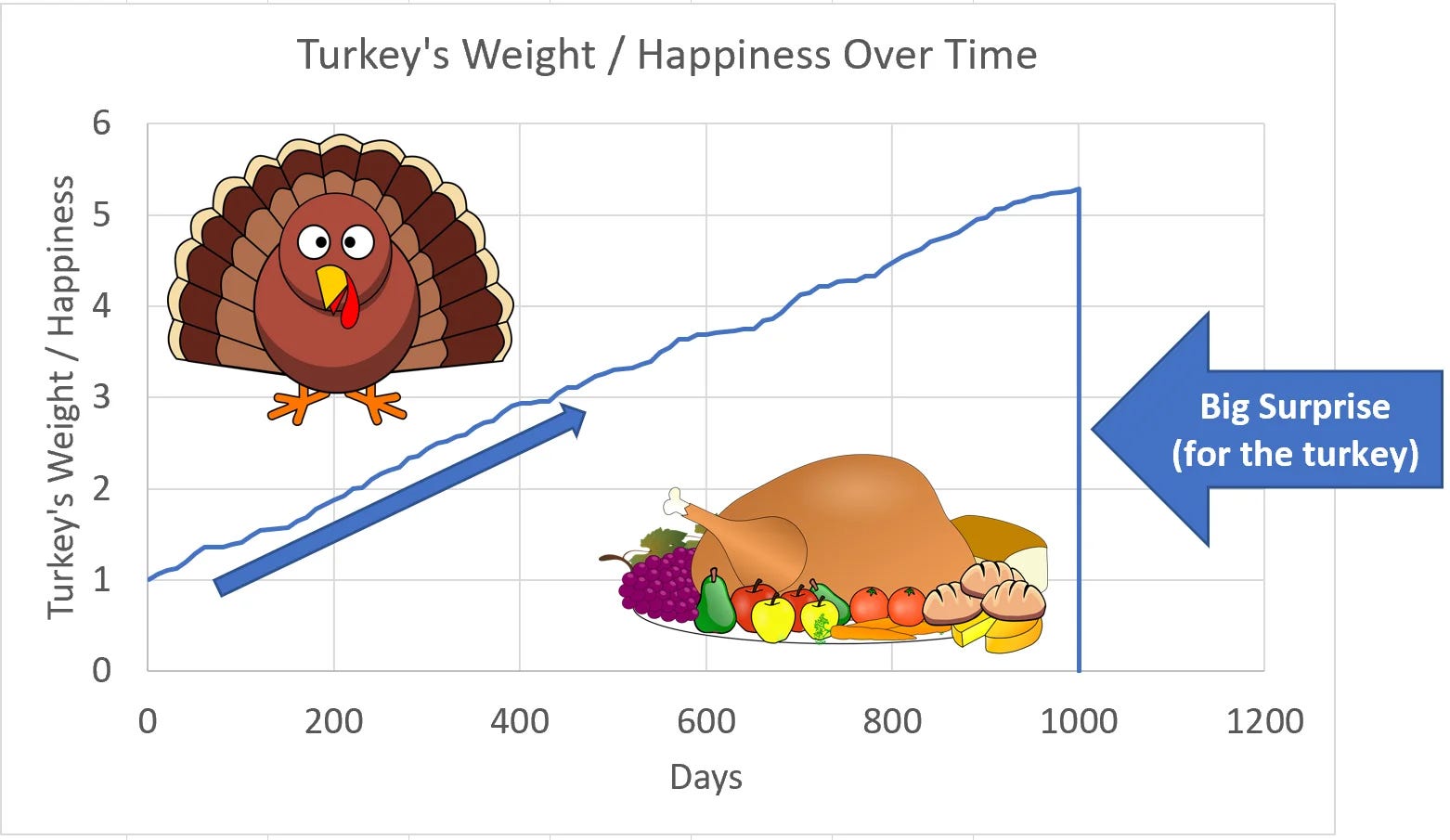
Are engineers, or all knowledge workers in general, turkeys, in this scenario? Should our “elasticity” and value of work be increasingly positive, right up to some crossover point we become horses? Now that SWE-Bench is saturated (with SWE-Bench Pro soon to be, Mythos is at 78%) and GDPval rates GPT 5.4 as better than/equal to human experts 83% of the time in most swathes of the economy, what’s left?
Notion is working on Notion’s Last Exam. Greg and Francois are have set out ARC-AGI-3. I’m working on the next frontier of coding evals. But it all seems somewhat moot if hardware is destiny and AGI is predictably a 20GW supercluster away…
…or are there more valuable problems left?
AI News for 4/3/2026-4/4/2026. We checked 12 subreddits, 544 Twitters and no further Discords. AINews’ website lets you search all past issues. As a reminder, AINews is now a section of Latent Space. You can opt in/out of email frequencies!
AI Twitter Recap
Top Tweets (by engagement)
Google’s Chrome “Skills” turns prompts into reusable browser workflows: Google introduced Skills in Chrome, letting users save Gemini prompts as one-click actions that run against the current page and selected tabs. Google also shipped a library of ready-made Skills, which makes this more than prompt history: it’s effectively lightweight end-user agentization inside the browser.
Tencent’s HYWorld 2.0 positions world models as editable 3D scene generators, not video models: Ahead of release, @DylanTFWang teased HYWorld 2.0 as an open-source, engine-ready 3D world model that generates editable 3D scenes from a single image.
Google DeepMind shipped Gemini Robotics-ER 1.6: The new model, announced by @GoogleDeepMind, improves visual/spatial reasoning for robotics, adds safer physical reasoning, and is available in Gemini API / AI Studio. Follow-up posts highlight 93% instrument-reading success and better handling of physical constraints like liquids and heavy objects.
OpenAI expanded Trusted Access for Cyber with GPT-5.4-Cyber: OpenAI says GPT-5.4-Cyber is a fine-tuned version of GPT-5.4 for defensive security workflows, available to higher-tier authenticated defenders under its Trusted Access program.
Hugging Face launched “Kernels” on the Hub: @ClementDelangue announced a new repo type for GPU kernels, with precompiled artifacts matched to exact GPU/PyTorch/OS combinations and claimed 1.7x–2.5x speedups over PyTorch baselines.
Cursor described a multi-agent CUDA optimization system built with NVIDIA: @cursor_ai says its multi-agent software engineering system delivered a 38% geomean speedup across 235 CUDA problems in 3 weeks, a concrete example of agents being applied to systems optimization rather than app scaffolding.
Agent Infrastructure: Hermes, Deep Agents, and Production Harnesses
Hermes Agent is becoming a serious open local-agent stack, with reliability and memory as the differentiators: Several posts converged on the same theme: users are migrating from alternatives to Hermes Agent because it is more durable for long-running work. The project shipped a substantial v0.9.0 update with web UI, model switching, iMessage/WeChat integration, backup/restore, and Android-via-tmux support via @AntoineRSX, while Tencent highlighted a one-click Lighthouse deployment for always-on cloud hosting with messaging integrations. On the memory side, hermes-lcm v0.2.0 from @SteveSchoettler adds lossless context management with persistent message storage, DAG summaries, and tools to expand compacted context. Community posts from @Teknium, @aiqiang888, and others reinforce that Hermes’ key advantage is less raw model IQ than operational stability, extensibility, and deployability.
LangChain is pushing “deep agents” toward deployable, multi-tenant, async systems: The deepagents 0.5 release adds async subagents, multimodal file support, and prompt-caching improvements. Related posts emphasize that
deepagents deployis an open alternative to managed agent hosting, with upcoming work around memory scoped to user/agent/org and custom auth / per-user thread isolation via @LangChain and @sydneyrunkle. The interesting pattern here is a shift from “agent demos” to platform concerns: tenancy, isolation, long-lived tasks, and integration surfaces like Salesforce and Agent Protocol-backed servers.Harness design is becoming a first-class engineering topic: Multiple posts argued that agent performance depends at least as much on the scaffold as the model. @Vtrivedy10 made the clearest case for task-specific open harnesses over ideology (“thin vs thick”), while @kmeanskaran stressed workflow design, memory switching, and tool output control over frontier-model chasing. This aligns with @ClementDelangue asking for a curated mapping from models to their best coding/agent harnesses, which is increasingly necessary as open-weight models diversify.
Robotics, World Models, and 3D Generation
Google’s Gemini Robotics-ER 1.6 is a notable productization step for embodied reasoning: The release from @GoogleDeepMind emphasizes better visual/spatial understanding, tool use, and physical constraint reasoning. Follow-ups note 10% better human injury-risk detection, support for reading complex analog gauges, and availability in the API; @_philschmid highlighted 93% success on instrument-reading tasks. This feels less like a robotics foundation-model paper drop and more like a developer-facing embodied-reasoning API.
World models are shifting from cinematic demos to editable spatial artifacts: Tencent’s HYWorld 2.0 teaser explicitly contrasted itself with video-generation systems by framing the output as a real 3D scene that is editable and engine-ready. On the web side, Spark 2.0 from @sparkjsdev shipped a streamable LoD system for 3D Gaussian splats, targeting 100M+ splat worlds on WebGL2 across mobile, web, and VR. Together these suggest the stack for “AI-generated 3D” is maturing from content generation into interactive rendering and downstream use.
Open 3D generation is advancing on topology, UVs, rigging, and animation readiness: @DeemosTech introduced SATO, an autoregressive model for topology and UV generation, while @yanpei_cao released AniGen, which generates 3D shape, skeleton, and skinning weights from one image. These are meaningful because the bottleneck in production 3D pipelines is rarely “can you generate a mesh?”; it’s whether the asset is structured enough to animate, texture, and edit.
Models, Benchmarks, and Specialized Systems